Housing in Black America
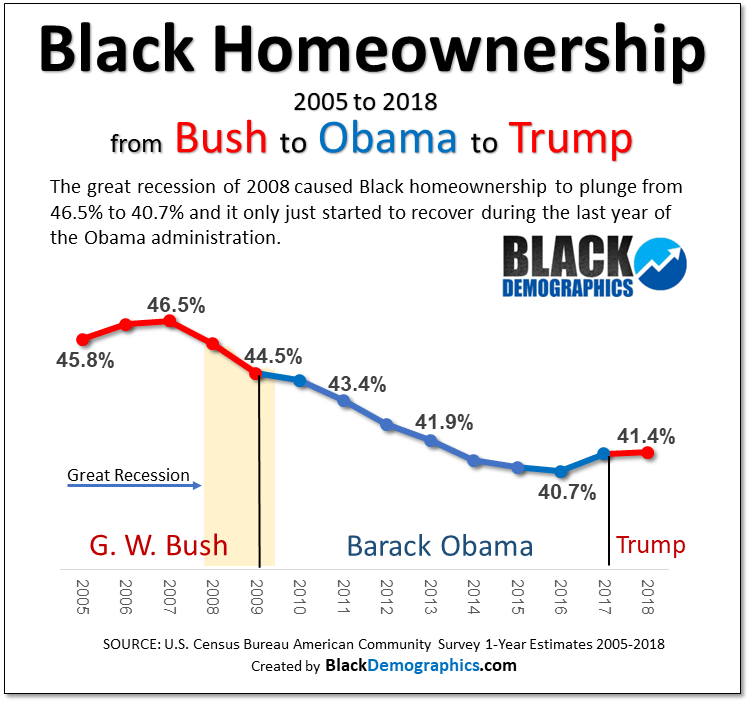
Many working-class Black Americans continue to face challenges in obtaining affordable housing. Black homeownership decreased between 2005 and 2017 from 46% to 41.4% While there have been some positive changes since 2017, the struggle remains significant.
Much of the losses can be attributed to the housing crisis, during which many Americans lost their homes to foreclosure. Unfortunately, the Black population has been the last to see an upward trend in homeownership. This also means, more than half of all African Americans continue to rent their homes.
Black Homeowner Statistics

This page uses the 2024 American Community Survey (ACS) 1-year estimates (Table S0201) to summarize homeownership, renting, and housing type outcomes for Black households and compare them to the Total U.S. population.
Where historical figures are referenced (2005, 2012, 2017, 2022), they reflect ACS estimates for those years, as previously recorded on this page. Dollar figures in ACS are inflation-adjusted.
Homeownership
Homeownership
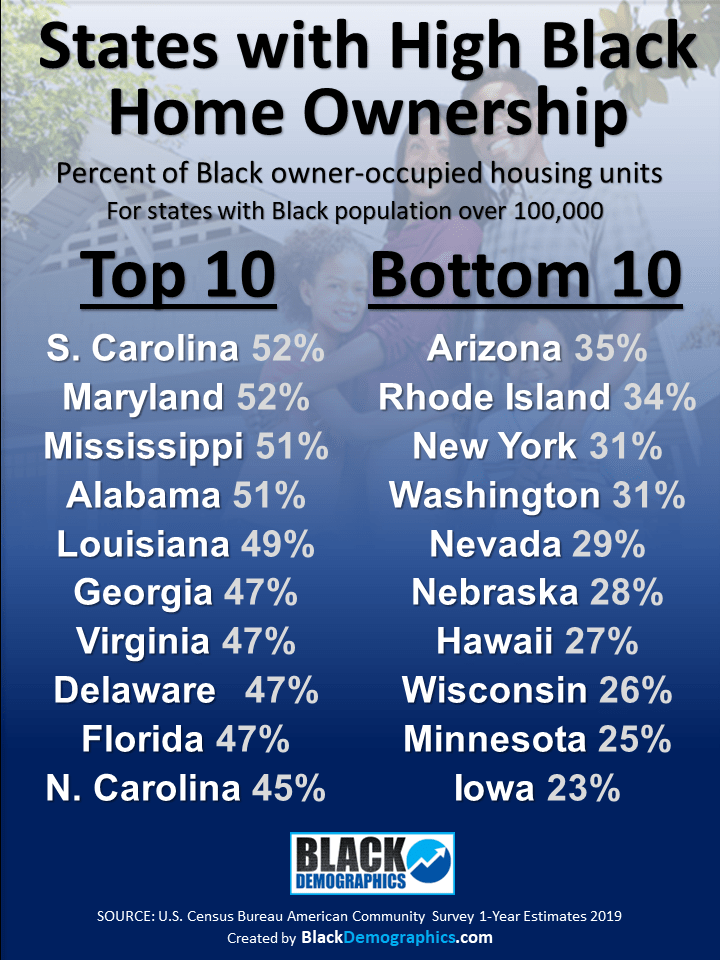
In the 2024 ACS, 45.1% of Black households are homeowners, compared with 65.3% for the total U.S. population. While the 2024 Black homeownership rate is higher than the 2022 ACS figure (44%), it remains slightly below the 2005 ACS level (46%).
Affordability remains a major constraint. In the 2024 ACS, 38.5% of Black homeowners with a mortgage spend 30% or more of income on mortgage costs, compared with 29.4% for the total population, meaning Black homeowners are more likely to be “cost-burdened” under the common housing affordability benchmark.
Black homeownership trend (ACS):
- 46.0% (2005) → 41.4% (2017) → 44.0% (2022) → 45.1% (2024)
Black mortgage cost burden trend (30%+ of income)
- 40.0% (2005) → 43.9% (2012) → 35.9% (2017) → 38.5% (2024)
Source: U.S. Census Bureau, 2024 ACS 1-Year Estimates, Table S0201 (2023 inflation-adjusted dollars where applicable).
Black Renter Statistics
Rental Housing (2024 ACS)
The share of Black households that rent remains high. In the 2024 ACS, 54.9% of Black households are renters, compared with 34.7% for the total U.S. population. While the Black renter share is slightly lower than the 56% recorded for 2022 on this page, Black households remain far more likely to rent than the population overall.
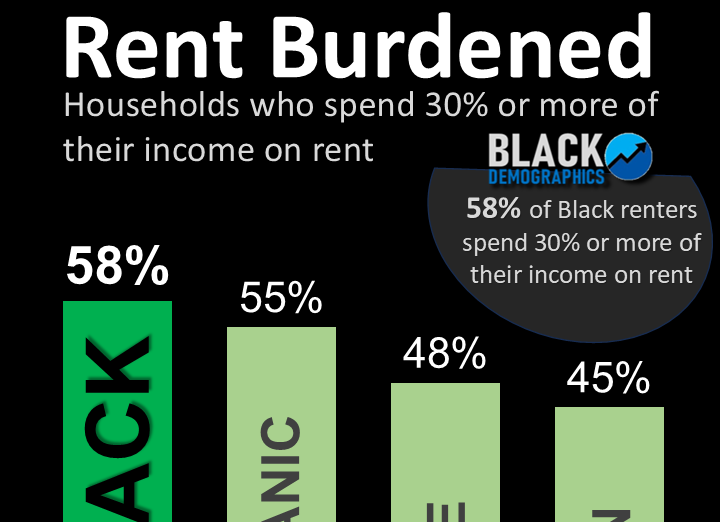
The affordability picture remains challenging. The median monthly rent for Black renter households is $1,341 (2024 ACS), and 58.8% of Black renters spend 30% or more of income on rent—a level of rent burden well above the total U.S. rate of 51.8%. By the common affordability benchmark (no more than 30% of gross income on housing), this indicates a majority of Black renters are cost-burdened.
ACS rental trend (Black renters)
- Black Median monthly rent: $820 (2012) → $920 (2017) → $1,167 (2022) → $1,341 (2024)
- Black rent burden (30%+ of income): 53.0% (2005) → 59.2% (2012) → 56.3% (2017) → 58.8% (2024)
- Percent renters (Black): 56% (2022) → 54.9% (2024)
Source: U.S. Census Bureau, 2024 ACS 1-Year Estimates, Table S0201 (2023 inflation-adjusted dollars where applicable).
Black Housing Types
Housing Types (2024 ACS)
Black Americans remain less likely to live in single-family homes than the population overall, and more likely to live in larger multifamily buildings. In the 2024 ACS, 55.2% of Black housing units are single-family homes compared to 68.7% for the total U.S. population. Meanwhile, 29.7% of Black housing units are in large apartment buildings (5+ units), compared to 18.9% nationally.
Housing types (Black vs. Total USA, 2024 ACS):
- Single-family homes: 55.2% vs. 68.7%
- Small apartment buildings (2–4 units): 11.6% vs. 7.3%
- Large apartment buildings (5+ units): 29.7% vs. 18.9%
- Mobile home, boat, RV, van, etc.: 3.5% vs. 5.2%
Source: U.S. Census Bureau, 2024 ACS 1-Year Estimates, Table S0201.
Conclusion (updated)
Across homeownership, renting, and housing type, significant disparities remain between Black households and the U.S. overall. The 2024 ACS shows that Black households are less likely to be homeowners and more likely to rent, and Black renters and homeowners are more likely to face housing cost burdens under the common affordability benchmark.
Financial experts often recommend keeping housing costs at no more than 30% of gross income, yet in the 2024 ACS:
- 58.8% of Black renters spend 30%+ of income on rent (vs. 51.8% Total USA), and
- 38.5% of Black homeowners with a mortgage spend 30%+ of income on mortgage costs (vs. 29.4% Total USA).
These cost pressures—combined with the continued gap in homeownership—underscore the ongoing need for policies and market solutions that expand affordable housing access and reduce housing-related financial strain.
CLICK TO ENLARGE
CLICK IMAGE TO ZOOM
HOUSING ARTICLES
Earn Less – Pay More: The Housing Burden on Black Households

The Real Estate Reality: Black and White Homeownership and Rental Differences