

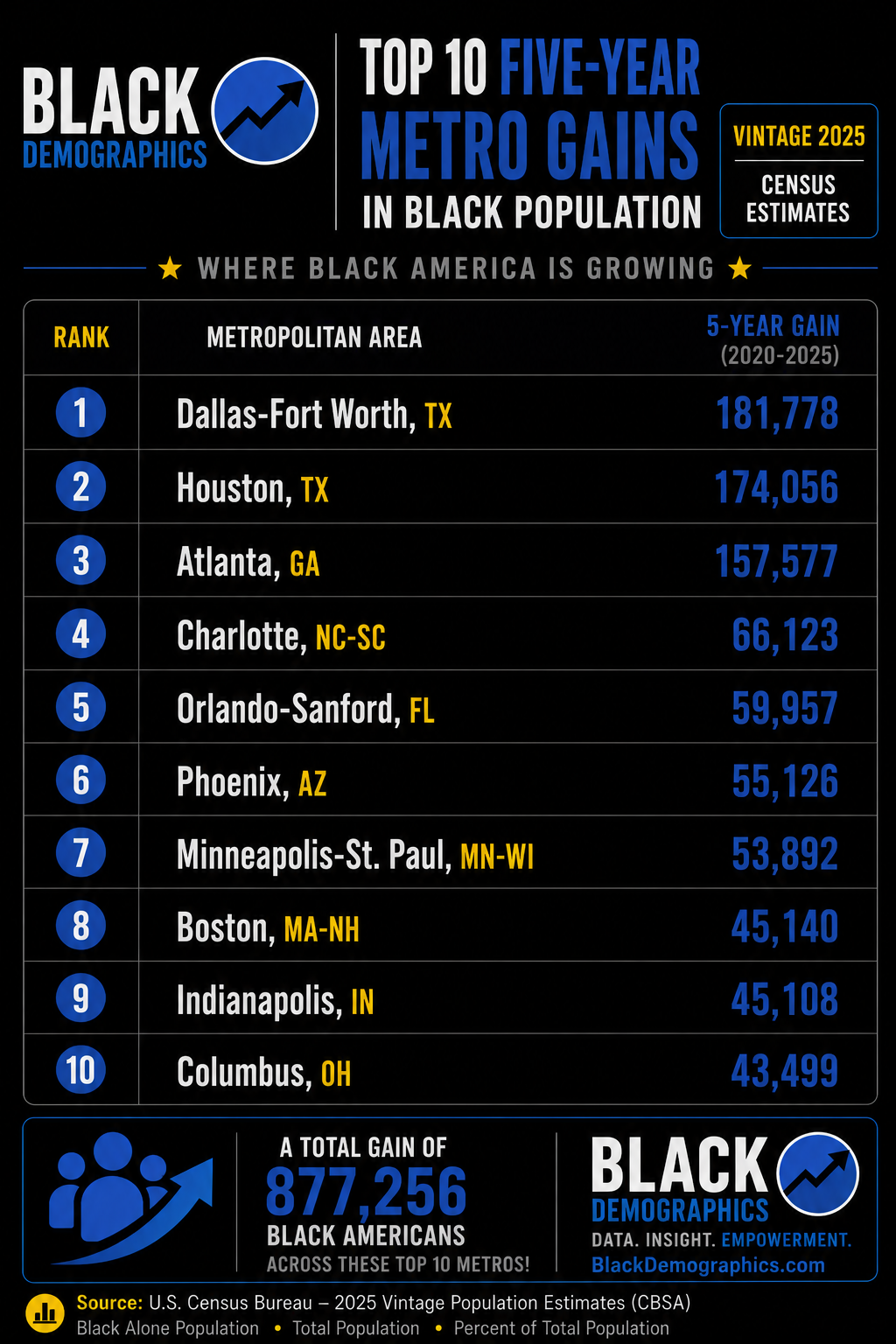
The nation’s fastest-growing Black metropolitan areas are increasingly concentrated in the South and Southwest, according to the June 2026 release of the U.S. Census Bureau’s Vintage 2025 Population Estimates.
Between 2020 and 2025, the ten metropolitan areas with the largest gains added a combined 877,256 Black residents, highlighting where much of the nation’s Black population growth has occurred over the past five years.
No state had a larger impact on Black metropolitan growth than Texas. Dallas-Fort Worth added 181,778 Black residents during the five-year period, the largest increase of any metropolitan area in the country. Houston ranked second with a gain of 174,056. Together, Texas’ two largest metropolitan areas added 355,834 Black residents, accounting for more than 40% of the combined growth among the nation’s ten fastest-growing metropolitan areas.
Atlanta continued to rank among the nation’s leading destinations for Black population growth, adding 157,577 residents between 2020 and 2025. Charlotte, Orlando, Phoenix, Minneapolis-St. Paul, Boston, Indianapolis, and Columbus also recorded substantial gains, illustrating that Black population growth is occurring across a wide range of metropolitan areas.
Top 10 Metropolitan Areas by Black Population Growth (2020–2025)
| Rank | Metropolitan Area | Black Population Gain |
|---|---|---|
| 1 | Dallas-Fort Worth, TX | 181,778 |
| 2 | Houston, TX | 174,056 |
| 3 | Atlanta, GA | 157,577 |
| 4 | Charlotte, NC-SC | 66,123 |
| 5 | Orlando-Sanford, FL | 59,957 |
| 6 | Phoenix, AZ | 55,126 |
| 7 | Minneapolis-St. Paul, MN-WI | 53,892 |
| 8 | Boston, MA-NH | 45,140 |
| 9 | Indianapolis, IN | 45,108 |
| 10 | Columbus, OH | 43,499 |
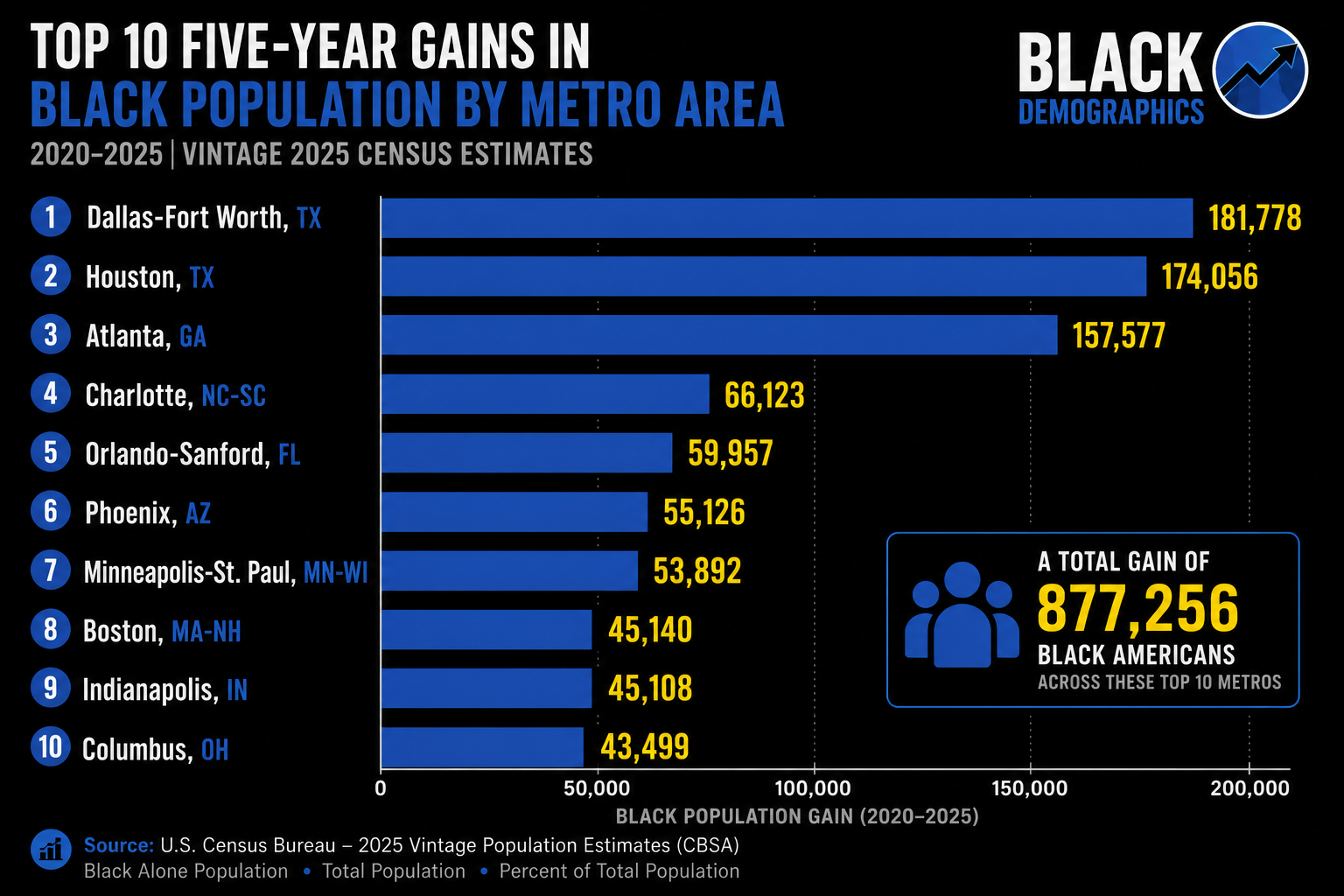
Texas Drives Black Metropolitan Growth
Texas stands apart from every other state in the latest estimates. Dallas-Fort Worth and Houston were the only metropolitan areas to add more than 170,000 Black residents between 2020 and 2025.
Combined, the two metros gained more than 355,000 Black residents over the five-year period, making Texas the nation’s leading contributor to Black metropolitan population growth.
Growth Extends Beyond Traditional Black Population Centers
Atlanta remains one of America’s largest centers of Black population growth, but the latest Census estimates show that growth is not limited to a handful of well-known destinations.
Metropolitan areas in the Southeast, Southwest, Midwest, and Northeast all appear among the nation’s fastest-growing Black population centers. Charlotte, Orlando, Phoenix, Minneapolis-St. Paul, Boston, Indianapolis, and Columbus each ranked in the top ten for Black population gains, reflecting growth across multiple regions of the country.
Economic Growth and Population Growth Often Go Together
Many of the metropolitan areas experiencing the largest increases in Black population are also among the nation’s fastest-growing regional economies. Expanding job markets, new housing development, and overall population growth have made these metropolitan areas attractive destinations for Americans from a variety of backgrounds.
While the Census estimates do not identify the reasons people move, the data indicate that Black population growth has been strongest in many of the same metropolitan areas experiencing significant overall growth.
Looking Ahead
As the nation’s population continues to change, metropolitan areas are likely to remain the primary engines of Black population growth. The latest estimates suggest that this growth is increasingly concentrated in rapidly expanding regions, particularly across Texas and the broader Sun Belt, while strong gains in places such as Minneapolis-St. Paul, Boston, Indianapolis, and Columbus demonstrate that growth is occurring well beyond the country’s traditional Black population centers.
Source
Source: U.S. Census Bureau, Population Division, Vintage 2025 Population Estimates (CBSA), Black Alone Population, 2020–2025. – released June 2026